Available forms:colourless oily liquid
pd_proNo:537964-ecd419dc-6536-45e7-b7e6-21b2c8548990
pd_productuse:
Contact us|
Physical properties |
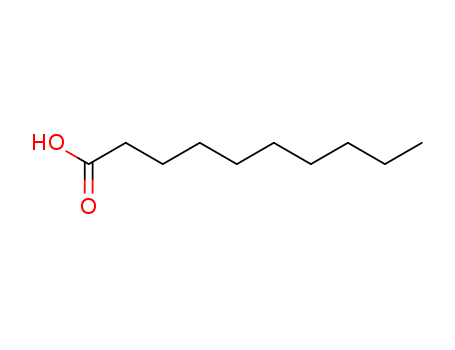
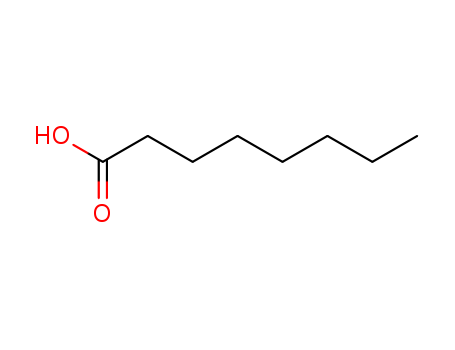
Caprylic acid, CH3(CH2)6COOH, also known as hexylacetic acid,n-octanoic acid, octylie acid, and octic acid, is a colorless, oily liquid having a mildly unpleasant odor and a burning, rancid taste. It is only slightly soluble in water (68 mg per 100 mL at 20°C). It is a natural component of coconut and palm nut oils and butter fat. Caprylic acid has also been identified in trace amounts in beer, brandy distillate, the essential oil of fermented Russian black tea leaves, and raw soybeans.It is used in manufacturing drugs and dyes. |
|
Definition |
ChEBI: Octanoic acid is a straight-chain saturated fatty acid that is heptane in which one of the hydrogens of a terminal methyl group has been replaced by a carboxy group. Octanoic acid is also known as caprylic acid. It has a role as an antibacterial agent, a human metabolite and an Escherichia coli metabolite. It is a straight-chain saturated fatty acid and a medium-chain fatty acid. It is a conjugate acid of an octanoate. |
|
Application |
Octanoic acid is widely applied in various fields, It is an antimicrobial pesticide used as a food contact surface sanitizer in commercial food handling establishments on dairy equipment, food processing equipment, breweries, wineries, and beverage processing plants. In addition, caprylic acid is used as an algaecide, bactericide, and fungicide in nurseries, greenhouses, garden centers, and interiorscapes on ornamentals. Products containing caprylic acid are formulated as soluble concentrate/liquids and ready-to-use liquids.Caprylic acid is also used in the treatment of some bacterial infections. Due to its relatively short chain length it has no difficulty in penetrating fatty cell wall membranes, hence its effectiveness in combating certain lipid-coated bacteria, such as Staphylococcus aureus and various species of Streptococcus.Octanoic acid is used commercially in the production of esters used in perfumery and also in the manufacture of dyes.Some studies have shown that Caprylic acid is effective to excess calorie burning taken as a dietary supplement, resulting in weigh loss. |
|
Preparation |
Octanoic acid is produced by fermentation and fractional distillation of the volatile fatty acids present in coconut oil. |
|
Aroma threshold values |
Detection: 910 ppb to 19 ppm. Aroma characteristics at 1.0%: waxy, dirty, sweaty and cheesy fatty, with dirty oily and creamy dairy nuances. |
|
Taste threshold values |
Taste characteristics at 10 ppm: creamy, waxy, dirty, sweaty, dairy cheeselike. |
|
Synthesis Reference(s) |
The Journal of Organic Chemistry, 54, p. 5395, 1989 DOI: 10.1021/jo00283a044Synthetic Communications, 19, p. 2151, 1989 DOI: 10.1080/00397918908052610 |
|
General Description |
Octanoic acid appears as a colorless to light yellow liquid with a mild odor. Burns, but may be difficult to ignite. Corrosive to metals and tissue. |
|
Flammability and Explosibility |
Notclassified |
|
Safety Profile |
Moderately toxic by intravenous route. Mildly toxic by ingestion. Mutation data reported. A skin irritant. Yields irritating vapors that can cause coughmg. When heated to decomposition it emits acrid smoke and irritating fumes. |
InChI:InChI=1/2C8H16O2.Sn/c2*1-2-3-4-5-6-7-8(9)10;/h2*2-7H2,1H3,(H,9,10);/q;;+2/p-2
-
A safe, straightforward, and atom econom...
-
Treatment with hydroxylamine and semicar...
A green and highly efficient oxidation o...
Resin glycosides are novel P-glycoprotei...
Bacterial luciferase catalyzes the monoo...
Pescapreins XXI-XXX (1-10), pentasacchar...
A series of silica-supported silver cata...
An ionic hybrid catalyst 1,1'-(butane-1,...
Two new fatty acid glucosides, 1,6-di-O-...
Fractional micellar ionization, α, and m...
Aldehyde dehydrogenase (ALDH) enzymes ar...
Ceramidases catalyze the cleavage of cer...
The basic hydrolysis of a number of aspi...
The choice of a suitable support for gol...
A new enzymatic reaction of carboxylic e...
Two new glycerol esters, (S)-2-hydroxy-3...
The use of platinum group metal (PGM) ca...
-
Keggin-type polyoxoanion PW12O403--conta...
Direct C-H oxidation of alkyl ethers int...
A novel catalyst of silver microparticle...
Fifteen new resin glycosides, marubajala...
Selective aerobic oxidation of alcohols ...
The oxidation of alcohols to aldehydes i...
-
In a good position: Nanoreactors can be ...
A versatile, solvent free aerobic alcoho...
Herein, three polyoxometalates, namely K...
Oxidation of long chain aldehydes is tru...
A methodology is introduced to separate ...
There is a need to develop effective cat...
-
The hydroformylation of olefins (oxo syn...
The total synthesis of 3,5-bis(perfluoro...
First and second-generation rigid dendri...
The homogeneous transition metal-catalyz...
Naproxen esterase (NP) from Bacillus sub...
The sonochemical behaviour of several or...
Co-Pd bimetallic alloy nanoparticle cata...
-
Zanamivir (ZA) and guanidino-oseltamivir...
-
Hydrolyses of 2,4-dinitrophenyl acetate ...
The acceptorless dehydrogenation of dive...
A positively charged micelle loaded with...
Ir and Rh “PNP” complexes with different...
A visible-light-induced metal-free desul...

p-nitrophenyl-caprylate

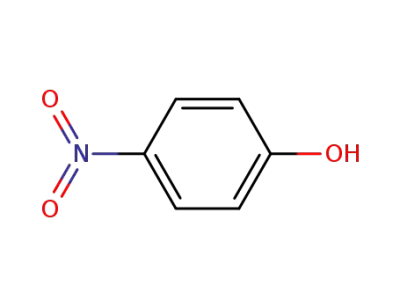
4-nitro-phenol

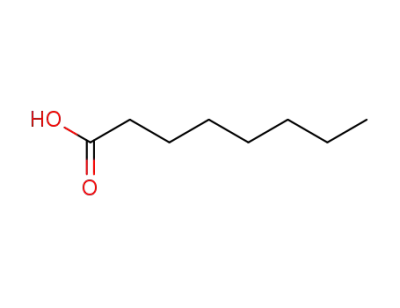
Octanoic acid
| Conditions | Yield |
|---|---|
|
With
dioctadecyldimethylammonium halogenide (Br, Cl); water;
In
ethanol; acetonitrile;
at 30 ℃;
Rate constant;
Kinetics;
alkaline hydrolysis, vesicle size-dependent properties, further solvents, also in absence of amphiphile;
|
|
|
With
N,N',N'',N'''-tetrakis-<10-
|
|
|
With
erythromycin A-hydrolyse prod.; water;
In
1,4-dioxane;
at 20 ℃;
Rate constant;
pH 12.171;
|
|
|
With
sodium hydrogencarbonate; sodium carbonate;
In
water; dimethyl sulfoxide;
at 45 ℃;
Rate constant;
effect of DMSO ratio;
|
|
|
With
water;
In
dimethyl sulfoxide;
at 45 ℃;
Rate constant;
pH=13.12; different substrate concentrations and ratios of solvents;
|
|
|
With
Carbonate buffer; alpha cyclodextrin;
In
water; dimethyl sulfoxide;
at 25 ℃;
Rate constant;
also with β-cyclodextrin;
|
|
|
With
phosphate buffer pH 11.6; dimethyl-β-cyclodextrin;
In
water;
at 25 ℃;
Rate constant;
reaction with γ-cyclodextrin or without cyclodextrin reagent;
|
|
|
In
various solvent(s);
at 25 ℃;
Rate constant;
also in the presence of dimethyl-β-cyclodextrin and γ-cyclodextrin;
|
|
|
With
sodium hydroxide; sodium hydrogencarbonate; sodium chloride;
In
1,4-dioxane;
at 35 ℃;
Rate constant;
var. conc. of ester;
|
|
|
With
octa(dimethylaminopropyl)resorcin<4>arene; water;
at 25 ℃;
Rate constant;
|
|
|
With
pH 11.6 phosphate buffer; cetyltrimethylammonim bromide; sodium bromide;
In
acetonitrile;
at 25 ℃;
Rate constant;
|
|
|
With
borate buffer; TMA-quaternized butyl methacrylate latex; water;
at 30 ℃;
Rate constant;
also in the presense of other trimethylamine or tributylamine quaternized latexes;
|
|
|
With
MES buffer; water; 1-Dodecyl-4-[1-(hydroxyimino)ethyl]pyridinium bromide;
at 25 ℃;
pH=7.2;
Further Variations:;
Reagents;
Kinetics;
|
|
|
With
sodium phosphate buffer; Aspergillus niger ZD11 pyrethroid hydrolase;
In
acetonitrile;
at 30 ℃;
pH=6.8;
Enzyme kinetics;
|
|
|
With
sodium phosphate buffer; Klebsiella sp. ZD112 pyrethroid-hydrolyzing esterase;
In
acetonitrile;
at 30 ℃;
pH=7.0;
Enzyme kinetics;
|
|
|
With
bovine submaxillary mucin type I; water;
at 37 ℃;
pH=7.2;
Reagent/catalyst;
Concentration;
Kinetics;
sodium phosphate buffer;
|
|
|
With
6-aminohexanoate cyclic dimer hydrolase Arthrobacter sp.;
at 30 ℃;
pH=7;
aq. phosphate buffer;
Enzymatic reaction;
|
|
|
With
EstEH112 esterase; water;
at 25 ℃;
pH=8;
GTA buffer;
Enzymatic reaction;
|
|
|
With
hydrogenchloride; recombinant Sulfolobus solfataricus P1 esterase; water; sodium taurocholate; 2-amino-2-hydroxymethyl-1,3-propanediol;
at 60 ℃;
pH=8.0;
Kinetics;
Enzymatic reaction;
|
|
|
With
carboxylesterase EstSt7 from Sulfolobus tokodaii strain 7; water;
In
ethanol;
at 80 ℃;
pH=9;
Kinetics;
Enzymatic reaction;
|
|
|
With
recombinant esterase from Rhizomucor miehei;
In
isopropyl alcohol;
at 50 ℃;
for 0.166667h;
pH=7.5;
Catalytic behavior;
Kinetics;
Enzymatic reaction;
|
|
|
With
Dactylosporangium aurantiacum subsp. Hamdenensis NRRL 18085 esterase WDEst17; water;
In
acetonitrile;
Kinetics;
Enzymatic reaction;
|
|
|
With
Dactylosporangium aurantiacum esterase WDEst9;
In
aq. phosphate buffer; ethanol; acetonitrile;
at 35 ℃;
for 0.0833333h;
pH=7.5;
Catalytic behavior;
Enzymatic reaction;
|
C36H60O30*C8H16O2
Octanoic acid

alpha cyclodextrin
| Conditions | Yield |
|---|---|
|
With
phosphate buffer;
In
water-d2;
at 25 ℃;
Equilibrium constant;
Thermodynamic data;
standard molar enthalpy ΔrH0, standard molar Gibbs energy ΔrG0, standard molar entropy ΔrS0;
|
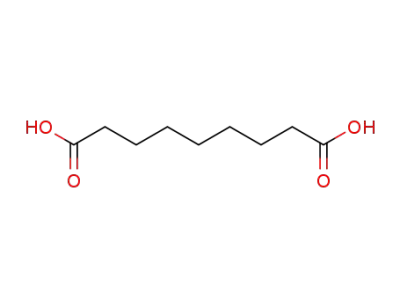
azelaic acid

octanol

octan-2-one oxime
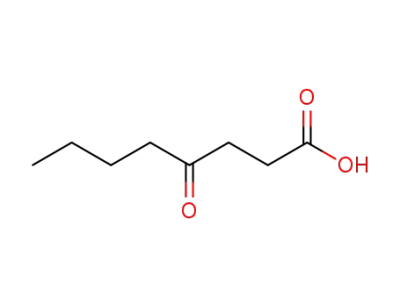
4-oxooctanoic acid

methyl octanate
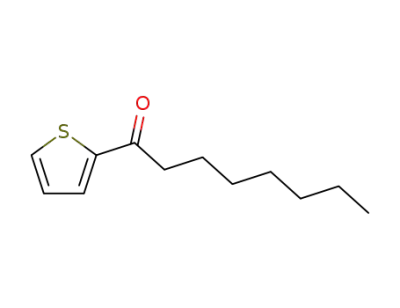
1-(thiophen-2-yl)octan-1-one

propyl octanoate

2,2-bis-(4-octanoyloxy-phenyl)-propane
For inquiries About Our Products, Please Leave Your E-Mail To Us And We will Contact You Within 24 Hours.