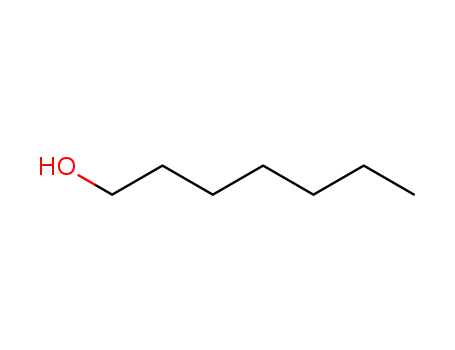
Available forms:colourless liquid
pd_proNo:510051-c81c84e7-7cfd-4104-ac68-a5d12f18cdaa
pd_productuse:
Contact us|
Preparation |
By reduction of enanthic aldehyde, which is a distillation product of castor oil. |
|
Production Methods |
1-Heptanol is produced by reacting hexenes with carbon monoxide in the oxo process or by the catalytic reduction of heptaldehyde. It has little commercial value except in fragrances and as an artificial flavoring agent. |
|
Synthesis Reference(s) |
The Journal of Organic Chemistry, 57, p. 1061, 1992 DOI: 10.1021/jo00030a003Synthesis, p. 701, 1979 DOI: 10.1055/s-1979-28800 |
|
Reactivity Profile |
Heptan-1-ol is an alcohol. Flammable and/or toxic gases are generated by the combination of alcohols with alkali metals, nitrides, and strong reducing agents. They react with oxoacids and carboxylic acids to form esters plus water. Oxidizing agents convert them to aldehydes or ketones. Alcohols exhibit both weak acid and weak base behavior. They may initiate the polymerization of isocyanates and epoxides. |
|
Hazard |
Combustible. |
|
Health Hazard |
Low toxicity; liquid may irritate eyes. |
|
Flammability and Explosibility |
Nonflammable |
|
Chemical Reactivity |
Reactivity with Water No reaction; Reactivity with Common Materials: No reactions; Stability During Transport: Stable; Neutralizing Agents for Acids and Caustics: Not pertinent; Polymerization: Not pertinent; Inhibitor of Polymerization: Not pertinent. |
|
Biochem/physiol Actions |
Taste at 1-10 ppm |
|
Purification Methods |
Shake the alcohol with successive lots of alkaline KMnO4 until the colour persists for 15minutes, then dry it with K2CO3 or CaO, and fractionally distil it. [Beilstein 1 IV 1731.] |
|
Aroma threshold values |
Detection: 3 ppb. |
|
General Description |
Watery colorless liquid with a weak alcohol odor. Floats on water. |
InChI:InChI=1/C7H16O/c1-2-3-4-5-6-7-8/h8H,2-7H2,1H3
It is demonstrated that anions α to the ...
Radical additions of HPR2 (R = Et, Cy) o...
A variety of aliphatic and aromatic keto...
The reduction of salicylaldehyde by pyri...
CuH and CuBpin are versatile catalysts a...
Electrochemical valorization of non-food...
(Octaethylporphyrinato)- or (tetraphenyl...
The reaction was investigated to elucida...
A general protocol for the synthetically...
The aldehydes RCHO (R = p-tolyl, p-anysi...
A new representative of an unusual famil...
-
-
The carbonyl reductase activity exhibite...
A series of sterically hindered manganes...
A first effort employing a range of pola...
Treatment of tetrahydropyranyl(THP) ethe...
The potential for expanding the variety ...
The reduction of a carbonyl by SmI2-wate...
A new route to the synthesis of a number...
Ruthenium encapsulated in an aluminium o...
Reduction of a wide range of aldehydes a...
Water-dispersible Pd nanoparticles stabi...
Ketones and aldehydes are conveniently a...
Shilov-chemistry inspired catalysis has ...
We investigated Baeyer–Villiger monooxyg...
Although zeolite-encapsulated [Rh(CO)x(P...
The one-pot synthesis of butanol and hep...
β-Tetrabromo-meso-tetrakis(4-methoxyphen...
-
Cp2TiCl2-catalyzed Grignard reactions wi...
The scope of metal oxide modified noble ...
A segmented flow capillary microreactor ...
Aluminum amalgam in aqueous tetrahydrofu...
Aldehydes possess relatively high chemic...
Aldehydes and ketones have been reduced ...
The complex [RhH(PEt3)3] catalysed the h...
A phase transfer reagent derived from PE...
Hydroformylation of hex-1-ene catalysed ...
Carbonyl compounds have been reported to...
Two very hydrophilic polyols, pentaeryth...
Rhodium complexes modified by simple tri...
The use of the cobalt carbonyl phosphine...
The development of catalytic aerobic epo...
Phenylene-bridged diphobane ligands with...
The reductive activity of various basidi...
The invention discloses an interworking ...

1-hexene

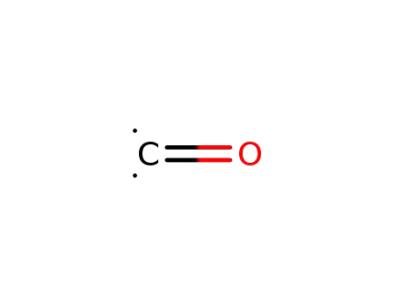
carbon monoxide


heptanal
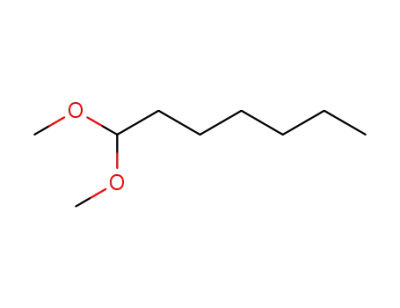
1,1-dimethoxyheptane

2-methylhexanal

2-ethylpentanal

2-methylhexan-1-ol

n-heptan1ol
| Conditions | Yield |
|---|---|
|
With
tributylphosphine; hydrogen; cobalt(II) acetate;
In
methanol;
at 80 ℃;
for 18h;
under 60800 Torr;
Product distribution;
Irradiation;
other hexene isomers, influence of phosphine concentration, temperature, reaction time, CO partial pressure, other catalyst: HCo(CO)2(PBu3)2; thermal reaction with catalyst HCo(CO)3PBu3;
|
13.4 % Chromat. 0.78 % Chromat. 0.07 % Chromat. 0.11 % Chromat. |
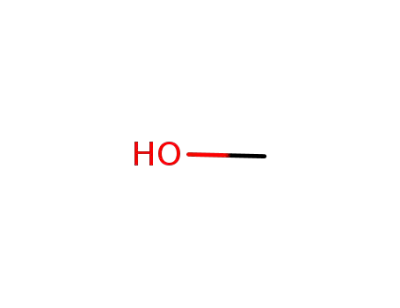
methanol
1-hexene
carbon monoxide
heptanal
1,1-dimethoxyheptane
n-heptan1ol

methyl heptanoate
| Conditions | Yield |
|---|---|
|
With
dicobalt octacarbonyl; hydrogen;
at 129.85 ℃;
under 22.5018 Torr;
Further Variations:;
Reagents;
Product distribution;
|

oxirane

n-pentylmagnesium bromide

pentane
heptanal

D,L N-2,6-difluorobenzoyl-3-aminobutyric acid heptyl ester

Nicotinsaeure-heptylester

heptyl acetate

n-heptyl chloroformate
For inquiries About Our Products, Please Leave Your E-Mail To Us And We will Contact You Within 24 Hours.