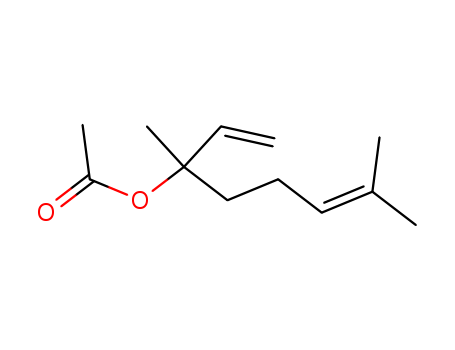
Available forms:clear colourless liquid
pd_proNo:506515-4980c0db-7af7-4ebc-b0ab-767205bca4cf
pd_productuse:
Contact us|
Reference |
https://pubchem.ncbi.nlm.nih.gov/compound/linalyl_acetate#section=Top A. Martin, V. Silva, L. Perez, J. Garcia-Serna, M. J. Cocero, Direct Synthesis of Linalyl Acetate from Linalool in Supercritical Carbon Dioxide: A Thermodynamic Study, Chemical Engineering & Technology, 2007, vol. 30, pp. 726-731 H. Surbung, J. Panten, Common Fragrance and Flavor Materials: Preparation, Properties und Uses, 2006, ISBN 978-3-527-31315-0 C. S. Letizia, J. Cocchiara, J. Lalko, A. M. Api, Fragrance material review on linalyl acetate, Food and Chemical Toxicology, 2003, vol. 41, pp. 965-976 |
|
Preparation |
Linalyl acetate is synthesized by two methods: 1) Esterification of linalool requires special reaction conditions since it tends to undergo dehydration and cyclization as it is an unsaturated tertiary alcohol. These reactions can be avoided as follows: esterification with ketene in the presence of an acidic esterification catalyst below 30 °C results in the formation of linalyl acetate without any by-products. Esterification can be achieved in good yield, with boiling acetic anhydride, whereby the acetic acid is distilled off as it is formed; a large excess of acetic anhydride must be maintained by continuous addition of anhydride to the still vessel. Highly pure linalyl acetate can be obtained by transesterification of tert-butyl acetate with linalool in the presence of sodium methylate and by continuous removal of the tert-butanol formed in the process. 2) Dehydrolinalool, obtained by ethynylation of 6-methyl-5-hepten-2-one, can be converted into dehydrolinalyl acetatewith acetic anhydride in the presence of an acidic esterification catalyst. Partial hydrogenation of the triple bond to linalyl acetate can be carried out with, for example, palladium catalysts deactivated with lead. |
|
Contact allergens |
Structurally close to linalool, linalyl acetate is the main component of lavender oil and is commonly used in fragrances and toiletries, and in household cleaners and detergents as well. By autoxidation, it leads mainly to hydroperoxides, with a high sensitizing potent. |
|
Synthesis |
Normally prepared by direct acetylation of linalool; another method starts from myrcene hydrochloride, anhydrous sodium acetate and acetate anhydride in the presence of a catalyst; all synthetic methods tend to avoid the simultaneous formation (because of isomerization) of terpenyl and geranyl acetate. |
|
Aroma threshold values |
Detection: 1 ppm |
|
Taste threshold values |
Taste characteristics at 5 ppm: floral, green, waxy, terpy, citrus, herbal and spicy nuances. |
|
General Description |
Linalyl acetate is a monoterpene ester mainly found in lavandula essential oil. It is used as a flavoring agent in food industries, as well as a preservative additive in cosmetics and fragrances such as soaps, colognes, perfumes, and skin lotions. |
InChI:InChI=1/C12H20O2/c1-6-12(5,14-11(4)13)9-7-8-10(2)3/h6,8H,1,7,9H2,2-5H3/t12-/m1/s1
The effect of a number of factors on the...
The synthesis of (3S, 6S)-(+)-3,7-dimeth...
A bottleneck in the synthesis of the mod...
Selected plants within the Origanum, Men...
The invention provides a method for synt...
The advantageous properties of ethylene ...
The invention provides an aminopyridine ...
Special proton-gradient-transfer acid co...
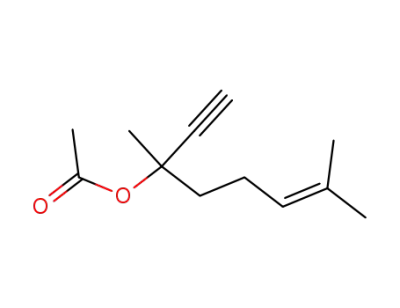
3,7-dimethyloct-6-en-1-yn-3-yl acetate

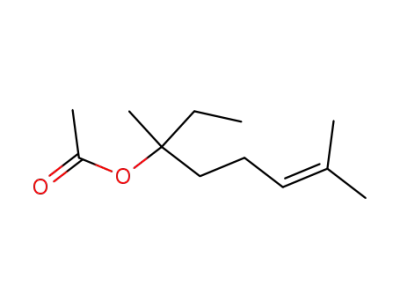
dihydrolinalool acetate

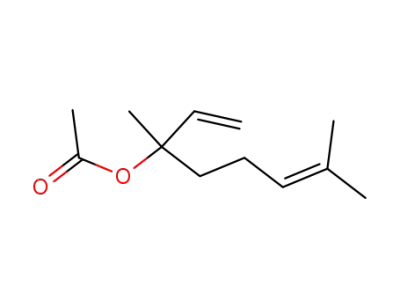
linalool acetate
| Conditions | Yield |
|---|---|
|
With
hydrogen;
Lindlar's catalyst;
In
octane;
at 20 ℃;
under 760 Torr;
Product distribution;
other solvents (ethanol, acetic acid), other catalyst (2.8percent Pd/C); dependence of reaction rate;
|
|
|
With
hydrogen; sodium carbonate;
Pd-BaSO4;
In
water; isopropyl alcohol;
at 30 ℃;
under 760 - 15200 Torr;
Product distribution;
other Pd catalysts tested, presence CdSO4 tested;
|
98 % Chromat. |
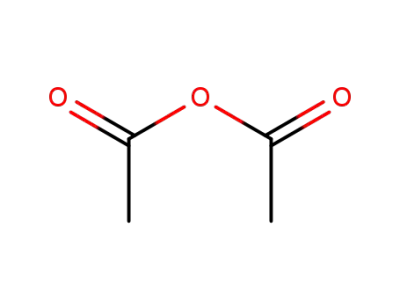
acetic anhydride

(S)-(+)-linalool
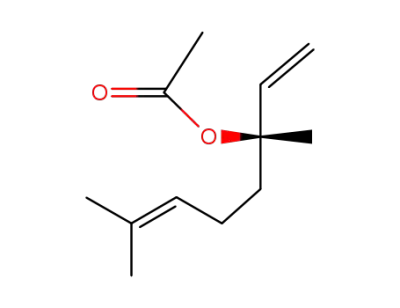
(S)-linalyl acetate
| Conditions | Yield |
|---|---|
|
With
dmap; triethylamine;
at 20 ℃;
for 10h;
|
70% |
|
With
pyridine; dmap;
at 90 ℃;
for 44h;
|

pyridine

3,7-dimethylocta-1,6-dien-3-ol
acetic anhydride

geranyl chloride
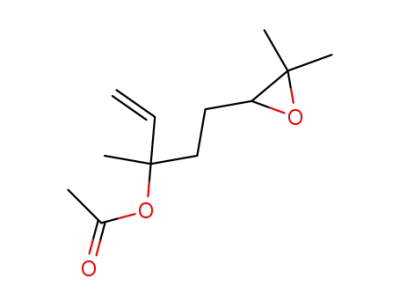
1-(3,4-epoxy-4-methylpentyl)-1-methylallyl acetate

7-methyl-3-methene-1,6-octadiene

2,6-dimethyl-hepta-1,5-diene

(E)-7,11-dimethyl-4,4-bis(phenylsulfonyl)dodeca-6,10-dien-1-yne
For inquiries About Our Products, Please Leave Your E-Mail To Us And We will Contact You Within 24 Hours.